




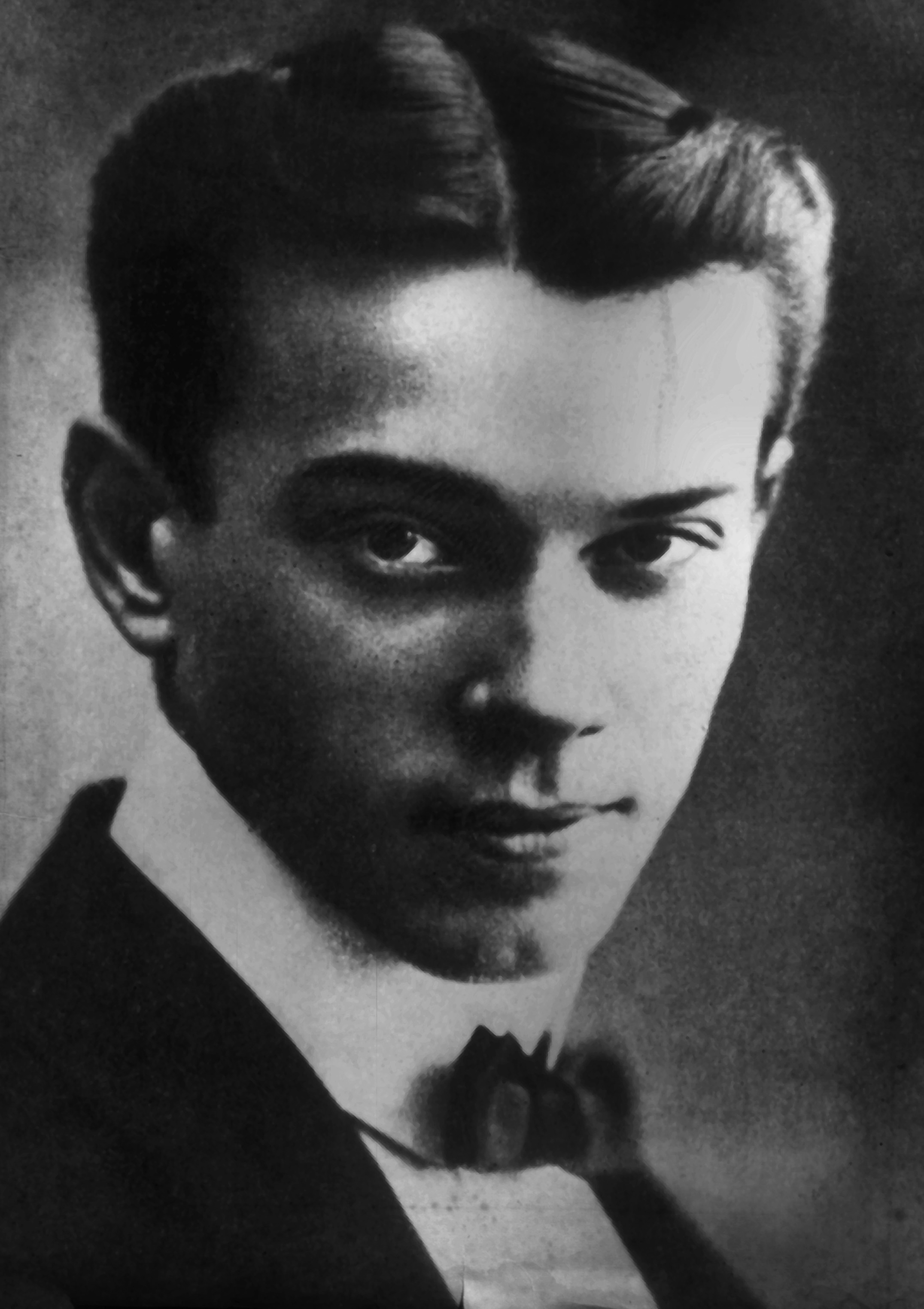
Vaslav Nijinsky is recognised as the greatest male dancer of all time and has been dubbed the god of dance. After a century of female ascendancy in ballet, he outdistanced the greatest ballerinas of his times: Kschessinska, Pavlova and Karsavina, establishing the primacy of male dance on the 20th-century dance stage.
His career lasted a mere 10 years, interrupted by a tragically incurable mental illiness. However, Nijinsky’s legend continued and will continue until another unique artistic personality appears who can outshine a whole ballet generation.
After leaving the St. Petersburg school, the 18-year-old Pole became the idol of the imperial Maryinsky Theatre. He was an inspiration for Diaghilev and the greatest asset of his Ballets Russes in the West. Fokine produced his best ballets for Nijinsky. Stravinsky, Ravel and Debussy composed music for him. Bakst and Benoit designed his costumes. He was painted by Bourdelle, Cocteau, Maillol, Modigliani, Sargent and Sidorov. Poets and writers have sung the praises of his dancing.
He electrified audiences with his marvellous grands jetés and pirouettes. He had an unusually flexible body and very strong power of expression. He created unforgettable roles in Les Sylphides, Le Carnaval, Sheherazade, Spectre de la rose, Narcisse, Petrushka, L’Après-midi d’un Faune, Daphnis and Chloe, Jeux, and Till Eulenspiegel. His interpretation of Prince Albert in Giselle is a model to this day.
He was also an extremely talented choreographer, though he prepared just four ballets: Debussy’s L’Après-midi d’un Faune and Jeux, Stravinsky’s Le Sacre du printemps, and Till Eulenspiegel to music by Richard Strauss. At the time, these works were so innovative they caused a scandal, but today they are described as brilliant choreography that was ahead of its time. (pch / trans. jd)
1889 Born in Kiev on 12 March.
1891 Christened in the Holy Cross Church in Warsaw on 30 April.
1896 First performance, in the role of Chimney Sweep in a circus pantomime in Vilnius.
1898 Enrolleds at the St. Petersburg Imperial Theatre School’s ballet department.
1905 School solo debut as the Faun in Acis et Galathée choreographed by Fokine.
1906 As a student, dancing partner to Vera Trefilova and Anna Pavlova.
1907 Graduated and joined the Maryinsky Theatre ballet company in St. Petersburg. Pas de deux in Petipa’s Giselle, Colas in Ivanov’s and Petipa’s La Fille mal gardée, the Prince in Kulichevskaya’s The Prince Gardener, Pas de trois in Petipa’s Swan Lake, the Slave in Fokine’s Le Pavillon d’Armide, the Blue Bird in Petipa’s The Sleeping Beauty.
1908 Becomes the principal dancer of the Maryinsky Theatre. The Poet in Fokine’s Chopiniana (revised as Les Sylphides), the Slave in Fokine’s Egyptian Nights (revised as Cléopatre), the Prince in Legat’s Flower of Alonka, Pas de trois in Petipa’s Paquita, Endymion in Petipa’s Le Roi Candaule.
1909 Took part in Diaghilev’s first Russian season in Paris: the Slave in Le Pavillon d’Armide, the Poet in Les Sylphides, the Slave in Cléopatre, Lezginka and the Blue Bird (in this case the Firebird) in Fokine’s divertissement The Feast. Returned to St. Petersburg. God of the Wind in Petipa’s Le Talisman.
1910 The Harlequin in Fokine’s Carneval, Kobold and the Oriental Dance in Fokine’s Les Orientales. Performances in Berlin. Participated in Diaghilev’s second Russian season in Paris: The Harlequin, Kobold, the Oriental Dance, the Gold Negro in Fokine’s Sheherazade, Albert in Giselle. Returned to St. Petersburg.
1911 Danced the part of Albert in Giselle in St. Petersburg and was expelled from the Maryinsky Theatre for wearing a costume the management considers inappropriate. Performs with Diaghilev’s company in Monte Carlo. Title roles in Fokine’s Spectre de la rose and Narcisse. Performs in Rome. Takes part in Diaghilev’s third Russian season in Paris. Title role in Fokine’s Petrushka. Performs in London: Albert in Giselle and Siegfried in Swan Lake.
1912 Takes part in Diaghilev’s fourth Russian season in Paris. Title roles in Fokine’s Le Dieu bleu, L’Après-midi d’un Faune (also Nijinsky’s debut as a choreographer) to music by Debussy, and in Fokine’s Daphnis and Chloe. Performs in London, Berlin and Budapest.
1913 Performs in Vienna and London. Takes part in Diaghilev’s fifth Russian season in Paris. Debussy’s Jeux and Stravinsky’s Le Sacre du printemps with Nijinsky’s choreography. Dances the part of the Young Man in Jeux. Performs in London and South America. Marries Romola Pulszky, a Hungarian, in Buenos Aires. Diaghilev terminates his contract with Nijinsky.
1914 Performs in London with his own ballet company. His daughter Kira is born. The Nijinskys are interned in Budapest and live with Romola’s mother till 1915.
1916 Returns to Diaghilev’s ballet company and performs in New York. Richard Strauss’s Till Eulenspiegel with Nijinsky’s choreography, with him in the title role. A grand tour of the United States: Boston, Washington, Kansas City, Des Moines, Omaha, Denver, Salt Lake City, Los Angeles, Hollywood, San Francisco…
1917 Seattle, Tacoma, Spokane, Saint-Paul, Minneapolis, Chicago, Michigan, Ohio, Indiana, Tennessee, Albany. Performs in Spain. On tour in South America. Last stage performances on 26 September, dancing Petrushka and Spectre de la rose. The first symptoms of mental illness.
1918 Settles in St. Moritz, Switzerland, with his family. Begins treatment. Starts writing a journal.
1919 The sick Nijinsky gives his last public performance, a kind of improvised and uncontrolled dance recital at the Suvrette Hotel in St. Moritz (19 January). The illness progresses, attempts at treatment are ineffectual.
1920 His second daughter Tamara is born.
1922 Diaghilev invites Nijinsky to rehearse with his ballet company in the hope of restoring him to sanity. No effect.
1924 Diaghilev invites Nijinsky a second time, the dancer meets the ballet company. No effect.
1928 For the last time the sick Nijinsky goes to see Petrushka performed by Diaghilev’s company at the Paris Opera.
1933 Romola Nijinsky’s monograph about Nijinsky is published in London.
1934 The French and American editions of Romola Nijinsky’s book are published.
1938 A newly invented insulin treatment is tried on Nijinsky. The treatment brings encouraging results and doctors claim he may regain his health completely.
1940 The Nijinskys are in Budapest, where they spend the war in difficult conditions. The disease returns. Romola Nijinsky publishes her husband’s Journal in Hungarian.
1944 Romola and her husband go to Sopron, Hungary, to escape Nazi persecution of the mentally ill.
1945 The Soviet army liberates Sopron and takes care of the Nijinskys. Nijinsky goes to Vienna and sees Galina Ulanova perform in Chopiniana (Les Sylphides).
1950 After several years of further ineffective treatment, Nijinsky dies in London on 8 April, following a kidney attack.
1953 Nijinsky’s ashes are brought to Paris and buried at the Montmartre Cemetery on 16 June. (pch / trans.jd)

 ''
''