




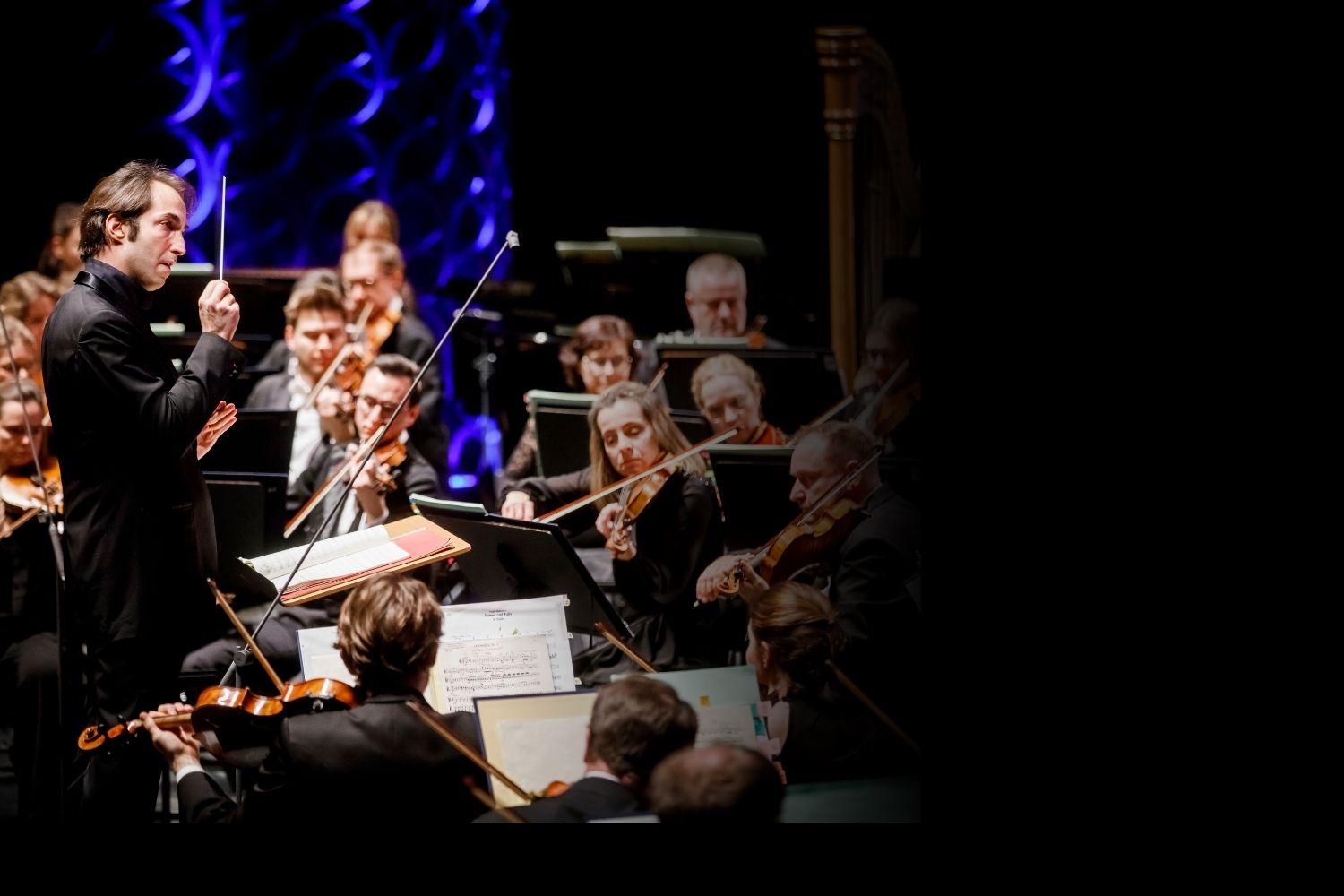
SZYMANOWSKI / GOLIJOV / TCHAIKOVSKY
Symphony concert
PROGRAMME
KAROL SZYMANOWSKI
Nocturne and Tarantella
OSVALDO GOLIJOV
Azul
cello concerto
PYOTR TCHAIKOVSKY
Symphony No. 6 in B minor ‘Pathétique’
PERFORMERS
Conductor YOEL GAMZOU
Cello MATTHEW BARLEY
Orchestra of the Polish National Opera
Contrasts can be a source of the most intense emotions. Calm and anxiety, light and darkness, movement and stillness: although seemingly exclusive, they often form a fascinating whole in music. It is precisely this tension between opposites that binds this concert programme together.
Karol Szymanowski’s Nocturne and Tarantella, Op. 28, were composed in 1915, first the contemplative Nocturne, then the energetic Tarantella a few months later. It would be hard to find more contrasting miniatures. The first captivates with its nocturnal atmosphere, subtle ornamentation, and melismas evoking Middle Eastern aesthetics. It is the quintessence of Szymanowski’s mature style. The second pulsates with rhythm and a dance-like vitality. Originally scored for violin and piano, the work was orchestrated in 1937 by Grzegorz Fitelberg, a conductor, composer, and Szymanowski's close friend. This impressive arrangement is performed relatively rarely today.
Azul, Osvaldo Golijov’s 2006 cello concerto, has a different kind of tension. The composer combined Latin American influences with a fascination for the Baroque, particularly François Couperin. The eponymous azul (‘blue’) initially referred to the cloudless skies above the summer open-air concerts at Tanglewood. A year after the premiere, performed by Yo-Yo Ma, Golijov decided to rework the piece. The new version had a different dynamic. It alluded to a clash of the elements: air versus fire, Earth versus the cosmos. Yoel Gamzou and cellist Matthew Barley will take listeners on a journey from the stars to the depths of the earth.
Following this cosmic journey, we will hear Pyotr Tchaikovsky’s Symphony No. 6 in B minor, ‘Pathétique’, Op. 74, a work as monumental as it is deeply personal. Here, too, contrasts build the tension. On the one hand, the symphony is imbued with a sense of grandeur and an almost religious tone, suggested by the subtitle suggested by the composer’s brother, Modest. On the other hand, it remains an intimate farewell. Instead of a triumphant finale, the music gradually fades away, dissolving into silence. The symphony was Tchaikovsky’s final work: the composer died just eight days after its premiere. ‘I have put my whole soul into this symphony, without exaggeration,’ he wrote in a letter to Archduke Konstantin Romanov.
Sponsors
-
Ministry of Culture and National Heritage of Poland
-

-
Patrons of the Polish National Opera
Partners of the Opera Academy
-

-

-
Patrons of the Polish National Opera
-

-

-

-
Supporting Partners of the Polish National Opera
-

-

-

-

-

-

-
Technology parner
-

-
Media patrons
-

-

-

-

-

-
Media partner
-

 ''
''