




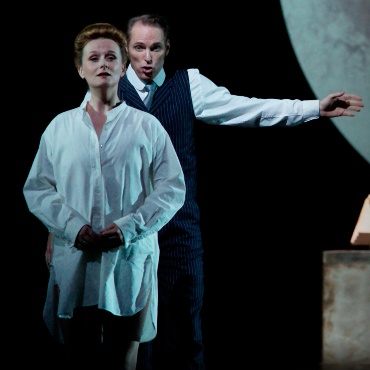
Thomas Adès is a British composer, pianist and conductor. Born in 1972 in London, he enrolled at Guildhall School of Music & Drama at the age of twelve to study piano with Paul Berkovitz and later composition with Robert Saxton. An imortant stepping stone in his career came in 1989 when he won the second prize in the BBC Young Musician of the Year competition. He later studied composition at King’s College, Cambridge with Alexander Goehr and Robina Hollowaya. He also trained with Hungarian composer György Kurtág.
Thomas Adès’s artistic career has blossomed instantaneously. In 1999–2008 he served as the artistic director of the Aldeburgh Festival, while premiering a series of his pieces. The first staging of his opera Powder Her Face, written in 1995, came in the same year (Almeida Opera, London). A year later the piece was then put on in Magdeburg, Germany. What followed was world-wide recognition and a commission from the Covent Garden.
Since that time Adès has performed as conductor with the world’s best ensembles: Los Angeles Philharmonic, London Symphony Orchestra, or the Royal Concertgebouw and at the most presigious international venues: the Berlin philharmonic hall, the Salle Pleyel in Paris, Carnegie Hall, or the Walt Disney Concert Hall. As for operas, he has conducted The Rake’s Progress at the Royal Opera House, and his second, and last for the time being, opera The Tempest at the Metropolitan Opera in New York. Adès has never given up his career as concert pianist.
Despite his young age, Adès is already a Royal Academy of Arts professor, and in 2004 he was given an honorary doctorate by the University of Essex. In 2007 a retrospective festival of his work was presented at the Barbican Arts Centre in London. Adès has been noticed by well-known recording companies already at the start of his career. Most of his works have been recorded by the globe’s best musicians: the Arditti Quartet, Berliner Philharmoniker under Sir Simone Rattle, Gabrieli Consort with Paul McCreesh, or Ian Bostridge. Among the most important distinctions given to Adès are a recommendation by International Rostrum of Composers and the Grawemeyer Award.
His works are influenced by English renaissance and baroque music. They also carry visible traces of romantic expression, while drawing inspiration from 20th century composers.
Controversies is a series of debates on the opera as a cultural phenomenon. The project offers space to talk contexts, search for news interpretations, venture into unknown territories.
In the 2014/15 season we will be reflecting on motifs from selected titles, reaching out to different arts -- especially the cinema. We have planned a series of film screenings to take place in Warsaw's studio cinemas, and serve as food for discussion. Terra incognita of old-time dilemas has already been conquered to some degree, yet the opera continues to prove that there is still more to discover...
I. "CIRCLES OF ALIENATION" IN OPERA -- THE MERCHANT OF VENICE
Taken from the title of Michał Głowiński’s book, such areas of incompatibility are important for the biography and musical oeuvre of Andrzej Czajkowski (André Tchaikowsky). A struggle with identity and constant tension between expectation and fulfilment defines the lines along which reflections on alienation develop. Gay? Jew? Utopia of coherence?
II. OPERA HUMANA -- MARIA STUARDA
Kant’s starry sky is sometimes overcast. Where should we seek advice? Psychoanalysis tries to answer questions on the imperative of human activity, on the driving force that controls our choices. Is it other people, our own experience, toxic parents, childhood, traumatic events, love or hatred? Why do we need responsibility and does a morality of music exist?
III. THE SYNAGOGUE OF SATAN -- POWDER HER FACE
The meanders of femininity are an inexhaustible theme. Woman controlled by desires, hysterical, a witch – battling this image has taken centuries. Never fear: this is just a masculine projection, a sublimation of male fears, specifically created in its own non-image – or so feminism reassures us. Is the Duchess of Argyle a woman enslaved or just the opposite – emancipated? Are the opinions about her an argument in the anti-feminist discus- sion or a victory for feminism? From Orpheus, through Przybyszewski, Poe and Dostoyevsky, to Berg and Adès.
IV. THE TERRITORIES OF OPERA -- THE 'P' PROJECT
The death of opera has been announced many times before. But today, does not the old term dramma per musica seem a more appropriate name? What challenges do 21st century artists face from opera as an art, and what from opera as an institution? What does it have that provokes, entices, repels? How do today’s generations of composers approach the reality of opera theatre? Is the composer struggling with the institution a battle whose result is a foregone conclusion? Creative strategies and work tactics – opera is (not) dead.
V. WITNESS OF THE TIMES -- WILLIAM TELL
An assassination attempt on Napoleon III was made in 1858. The emperor was on his way to see a production of William Tell. For decades Rossini’s opera had to wait in the vestibule of Milan’s La Scala. The Nazis banned it. It was cut, modified, it was politically and ideologically inconvenient. William Tell – a work of art as a witness of history.
 ''
''