




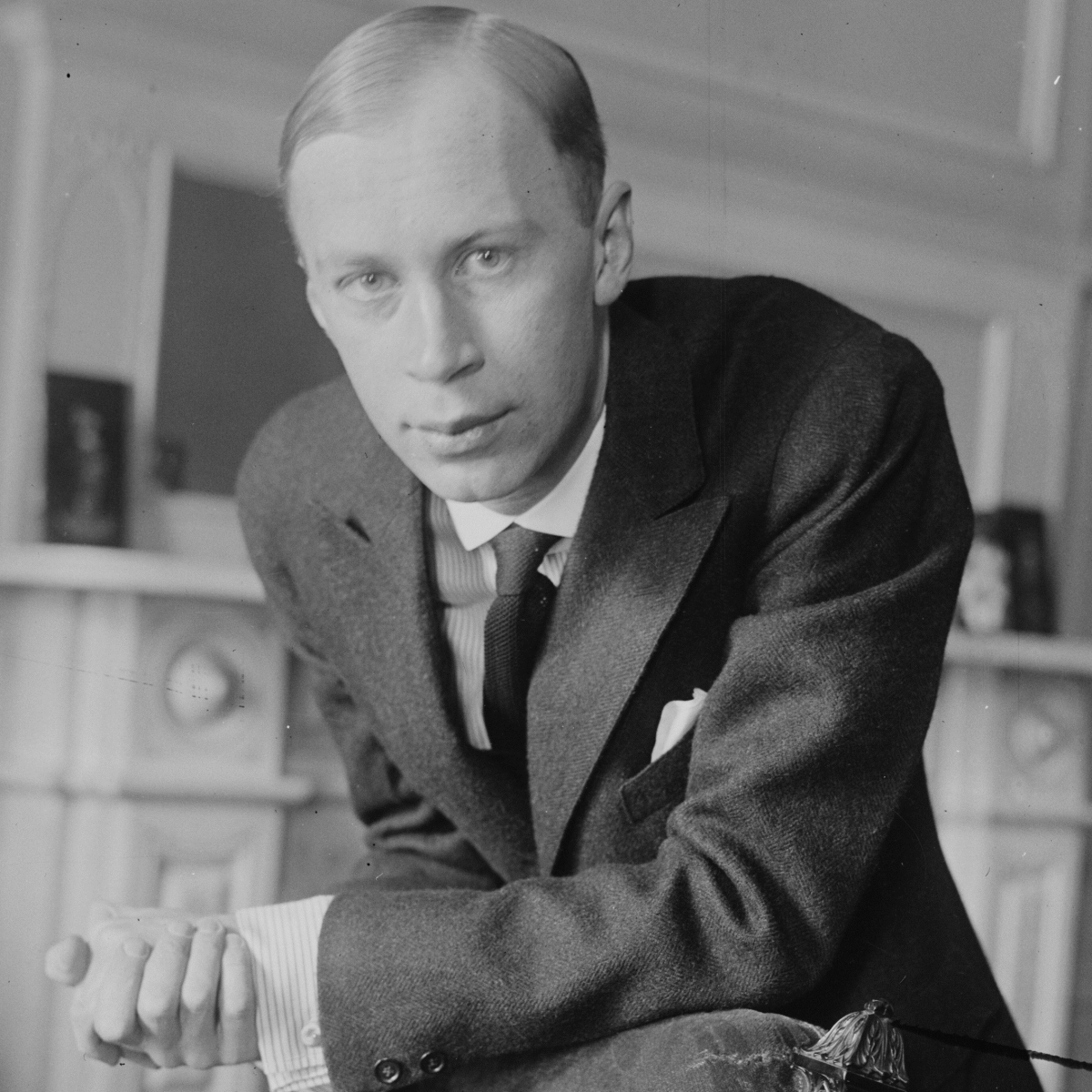
Russian composer, conductor and pianist Sergei Prokofiev (1809-1953) was one of the greatest music creators of the 21st century. He was born in present-day Ukraine. He wrote his first piece of music at the age of five. In 1904 he enrolled in the St Petersburg Conservatory to study harmony, counterpoint, instrumentation, piano, and conducting. He debuted as composer in 1908. He graduated in 1914, having taken part in a 'battle of the pianos', wich he won playing his Piano Concerto No. 1.
At first, Prokofiev was considered a leading avant-gardist and a man who rebells against composing clichés. He drew inspiration from Igor Stravinsky's and Maurice Ravel's works of the day. When he came back from Paris and presented his newly-written Piano Concerto No. 2, he was branded a 'musical Futurist' (1914). Soon, his most famous pieces saw the light of day: Scythian Suite and Classical Symphony (1917). In 1918, when the October revolution broke out, Prokofiev left for the USA. He came back to Europe in 1920, but he did not return to the USSR until 1936. In the meantime, he got married and started a family. His wife, Spanish singer Carolina Codina, later bacame the first performer of his songs.
He chose the worst time to move back to the USSR. Whilst the grip of Stalinist control tightened, Prokofiev was immediately forced to compose a series of 'mass songs'. During WWII he was evacuated to the Caucasus together with other artists. In 1948, based on the country's newly adopted cultural policy, Prokofiev was condemned for 'antidemocratic formalism'. His wife was arrested, charged with espionage, and detained in a labour camp for twenty years.
Sergei Prokofiev died on the same day as Jozef Stalin, 5 March 1953. He is most famous for his five piano concertos, seven symphonies, the ballet Romeo and Juliet, and the symphonic fairy tale, Peter and the Woolf. He also wrote music for the films of Sergei Eisenstein, the pioneer of Russian cinema (e.g. Alexander Nevsky).
ROMEO AND JULIET
Sergei Prokofiev
Ballet in three acts | Libretto: Krzysztof Pastor and Willem Bruls after William Shakespeare | Premiere: 7 March 2014
 ''
''