




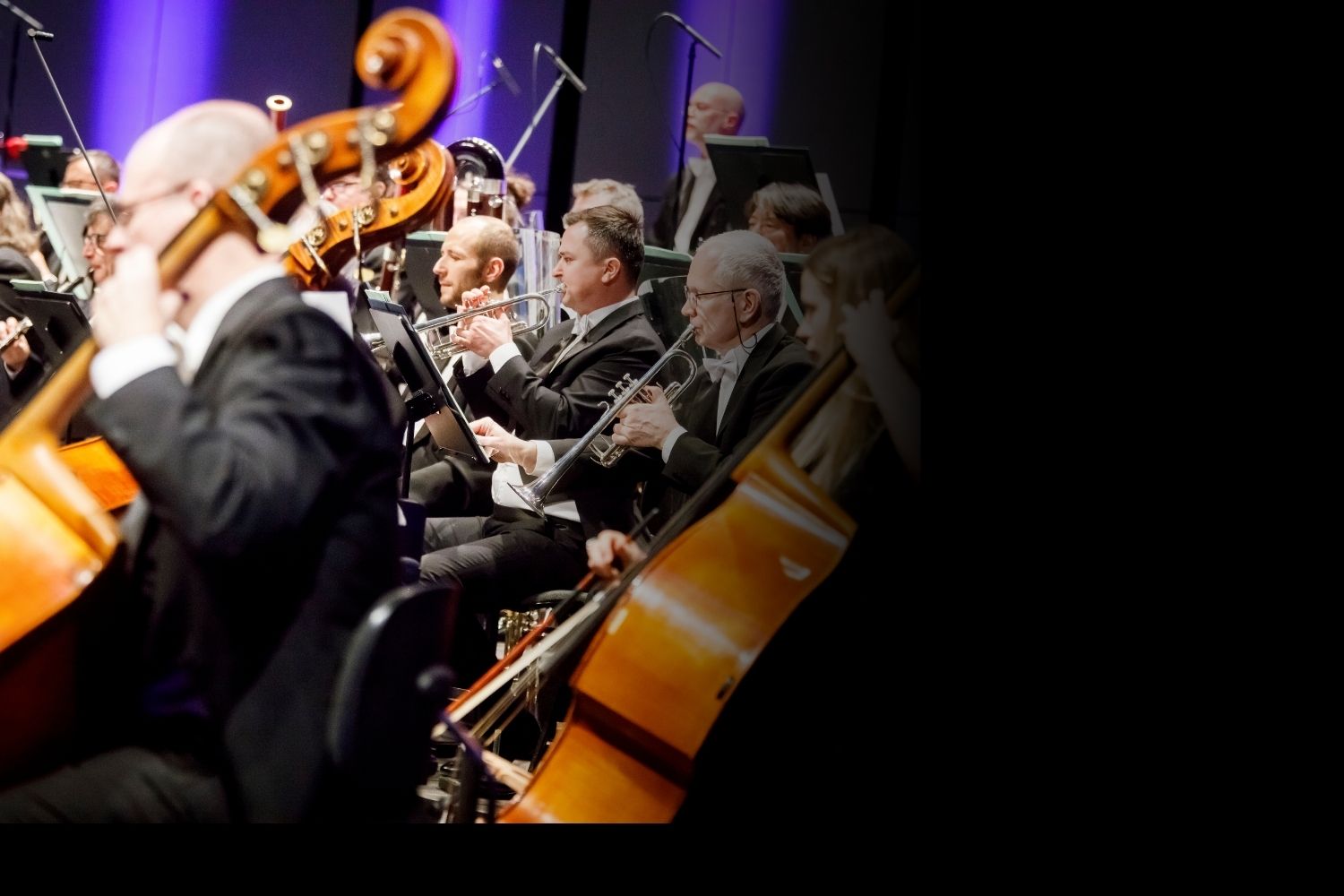
JOHANNES BRAHMS / EDWARD ELGAR
Symphony concert
PROGRAMME
JOHANNES BRAHMS
Piano Concerto No. 2
EDWARD ELGAR
Enigma Variations
PERFORMERS
Conductor MARK WIGGLESWORTH
Piano BORIS GILTBURG
Orchestra of the Polish National Opera
It is not easy to achieve worldwide success as a composer and remain a modest, sensitive individual. It takes a great deal of inner peace to remain true to oneself and not be swept away by the riches and pleasures. Two composers accomplished the difficult feat. Their immense fame did not change them; in fact, it strengthened their relationships with their loved ones. Their names were Johannes Brahms and Edward Elgar. Both were keen to express this – Brahms in his correspondence with friends, describing the creative process behind his Piano Concerto No. 2 in B flat major, Op. 83, and Elgar in the musical parodies of fellow musicians contained in his Enigma Variations, Op. 36.
‘I wrote a tiny, tiny piano concerto with a tiny, tiny wisp of a scherzo. It is in the B-flat major key and I am afraid I squeezed this udder, which has always yielded good milk before, too often and too vigorously,’ Brahms wrote in his letter to Elisabeth von Herzogenberg on 7 July 1881. His modesty clearly was exaggerated: the Piano Concerto No. 2 grew to impressive proportions and stands as a masterpiece of Romantic music today. The piece demands a virtuosic performance from both the soloist and the entire orchestra. Its first performers, the musicians of the Budapest Philharmonic Orchestra led by Alexander Erkel, accompanied the composer himself as soloist at the premiere on 9 November 1881. The challenging task of blending the piece's comedy with drama, intimacy with artistic virtuosity, and intimacy with creative success now rests on the shoulders of pianist Boris Giltburg. The winner of the 2013 Queen Elisabeth Competition will be accompanied by the Orchestra of the Polish National Opera under the baton of Mark Wigglesworth.
Edward Elgar’s Enigma Variations present no less of an interpretative challenge. The piece's premiere on 19 June 1899 at St James’s Hall in London was met with euphoria. TThis varied, superbly orchestrated cycle portrays the composer’s friends in a mostly sombre manner that can verge on humour and grandeur at times. As the composer wrote in a letter to August Jaeger on 24 October 1898: ‘The Variations have amused me because I’ve labelled ‘em with the nicknames of my particular friends – you are Nimrod. That is to say, I’ve written the variations for each one to represent the mood of the ‘party’…’
It should come as no surprise that Variation No. 9, entitled Nimrod, is one of the most famous movements in this cycle, though the majestic Variation No. 11 seems even more intriguing. Named after the organist George Sinclair, it was inspired by his bulldog, Dan, as indicated by the friendly composer's letters.
Sponsors
-
Ministry of Culture and National Heritage of Poland
-

-
Patrons of the Polish National Opera
Partners of the Opera Academy
-

-

-
Patrons of the Polish National Opera
-

-

-

-
Supporting Partners of the Polish National Opera
-

-

-

-

-

-

-
Technology parner
-

-
Media patrons
-

-

-

-

-

-
Media partner
-

 ''
''