




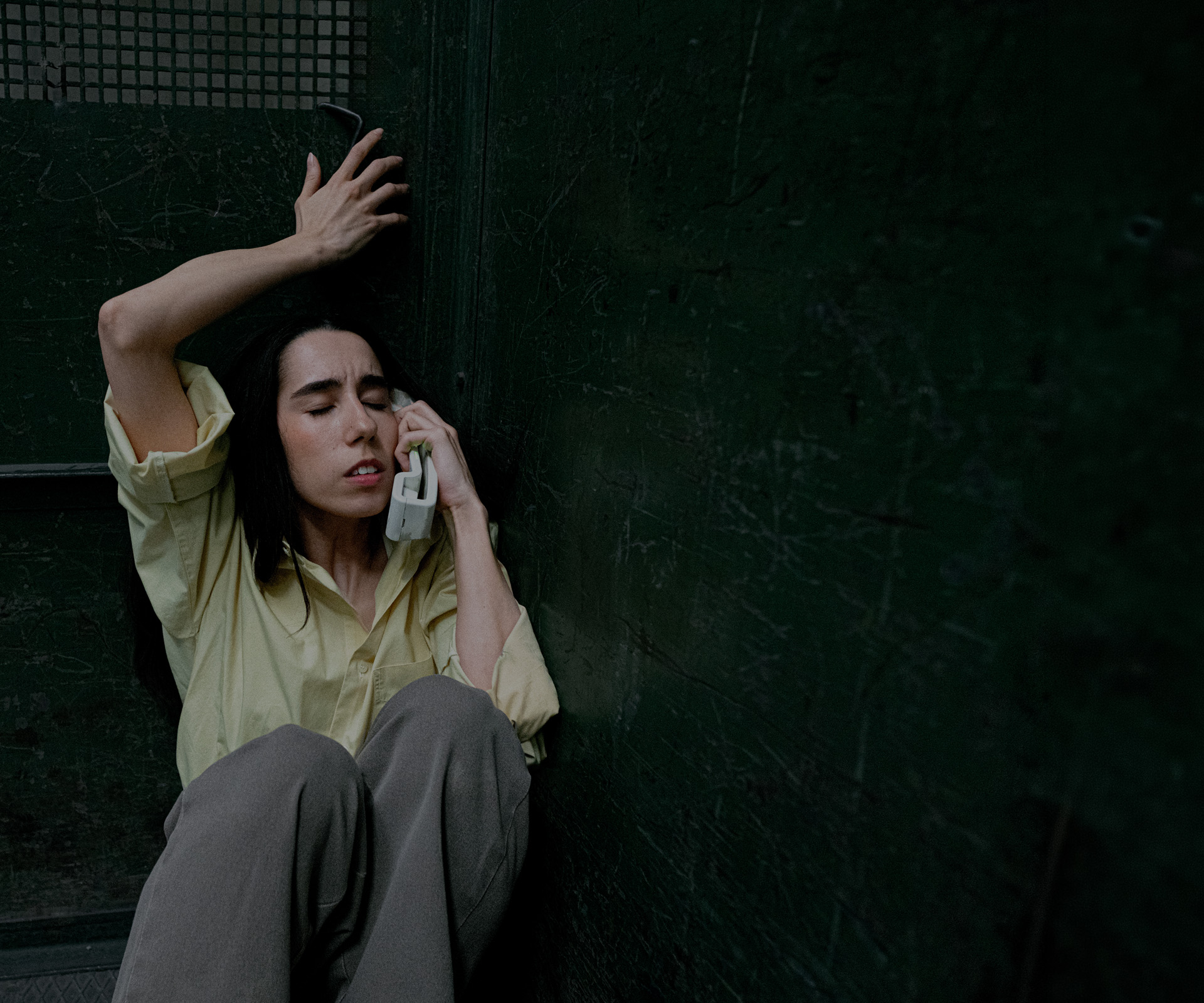
La Voix humaine
Another Silence
Erwartung
Francis Poulenc | Arnold Schönberg
La Voix humaine | Francis Poulenc
Lyric tragedy in one act
Piano version
World premiere: 06.02.1959, Opéra-Comique, Paris
Premiere: 25 March 2027
Co-production with Teatro Real, Madrid
In the original French with Polish and English surtitles
Another Silence
A theatrical poetical research
Created by: Maja Ostaszewska, Christof Loy
Based on Polish, German and French poems
Ewartung | Arnold Schönberg
One-act monodrama in four scenes
Libretto: Marie Pappenheim
World premiere: 6 June 1924, Prague
Premiere of this production: 25 March 2027
In original German with Polish and English surtitles
Co-production with: Teatro Real, Madrid
The monodramas focus on two women as they try to overcome life crises. Abandoned by her lover, the nameless heroine of Poulenc’s ‘tragédie lyrique’ is striving to free herself from her past. Seemingly calm and collected, she reveals her sorry state after a call from the unfaithful man. Glued to a telephone receiver for 40 minutes, she goes through different stages of a mental breakdown, only to give in to the old love. The unnamed woman in Schönberg’s monodrama is in an equally pitiful situation. Lost in a dark forest, she is searching for her lover. Eventually, she escapes the woods and finds her man, but their meeting is not what she expected.
In literary terms, the two stories have little in common. When writing the libretto, Schönberg used the help of Marie Pappenheim, a medical student and poet with close links to the psychoanalytic circles. His expressionist monodrama focuses on the protagonist's inability to articulate her agitation. The Woman in Cocteau's piece, which Poulenc used in his composition, is a compulsive talker, seemingly eager to transfigure reality with her words.
Both protagonists are strongly affected by the circumstances they find themselves in. The music seeks to reflect their emotions. To convey emotional instability, Schönberg creates an unbroken line of constant tension unfolding in an unknown direction; in a similar vein, though in his own musical language, Poulenc does not allow the audience a moment’s respite from the protagonist’s manic state. Both one-acters are distinguished by an anxious rhythm that conveys the women’s exhaustion and their fervent determination to save the world that is crumbling before their eyes.
Our guide on this journey across different states of love and despair is Christof Loy, one of the most successful opera directors now. The director conjures up a world in which silence is as important as the attempts to break it. The two parts of the double bill are separated by a dramatic etude, created by the director with legendary actress Rossy de Palma for the production’s premiere at the Teatro Real. Featuring texts by Oscar Wilde and Bertolt Brecht, the monologue will be performed in Warsaw by Maja Ostaszewska. Joining the actress onstage will be Malin Byström, a Swedish soprano specialising in portraying strong female characters.
Cast
-
-
The Woman (La Voix humaine)
 Marianne Croux
 -
Marthe (La Voix humaine)
 Maja Ostaszewska
 -
The Woman (Another Silence) Maja Ostaszewska
-
The Woman (Erwartung)
 Malin Byström
 -
The Man (Erwartung)
 Gorka Culebras
-
-
-
The Woman (La Voix humaine) Marianne Croux
-
Marthe (La Voix humaine) Maja Ostaszewska
-
The Woman (Another Silence) Maja Ostaszewska
-
The Woman (Erwartung) Malin Byström
-
The Man (Erwartung) Gorka Culebras
-
-
-
The Woman (La Voix humaine) Marianne Croux
-
Marthe (La Voix humaine) Maja Ostaszewska
-
The Woman (Another Silence) Maja Ostaszewska
-
The Woman (Erwartung) Malin Byström
-
The Man (Erwartung) Gorka Culebras
-
-
-
The Woman (La Voix humaine) Marianne Croux
-
Marthe (La Voix humaine) Maja Ostaszewska
-
The Woman (Another Silence) Maja Ostaszewska
-
The Woman (Erwartung) Malin Byström
-
The Man (Erwartung) Gorka Culebras
-
Credits
-
- Conductor
-
Director
 Christof Loy
 -
Set Designer Christof Loy
 Guadalupe Holguera
 -
Costumes Barbara Drosihn
- Lighting
 Robert Jindra
  Fabrice Kebour
 -
- Conductor
-
Director Christof Loy
-
Set Designer Christof Loy Guadalupe Holguera
-
Costumes Barbara Drosihn
- Lighting
-
- Conductor
-
Director Christof Loy
-
Set Designer Christof Loy Guadalupe Holguera
-
Costumes Barbara Drosihn
- Lighting
-
- Conductor
-
Director Christof Loy
-
Set Designer Christof Loy Guadalupe Holguera
-
Costumes Barbara Drosihn
- Lighting
Sponsors
-
Ministry of Culture and National Heritage of Poland
-

-
Patrons of the Polish National Opera
Partners of the Opera Academy
-

-

-
Patrons of the Polish National Opera
-

-

-

-
Supporting Partners of the Polish National Opera
-

-

-

-

-

-

-
Technology parner
-

-
Media patrons
-

-

-

-

-

-
Media partner
-

 ''
''